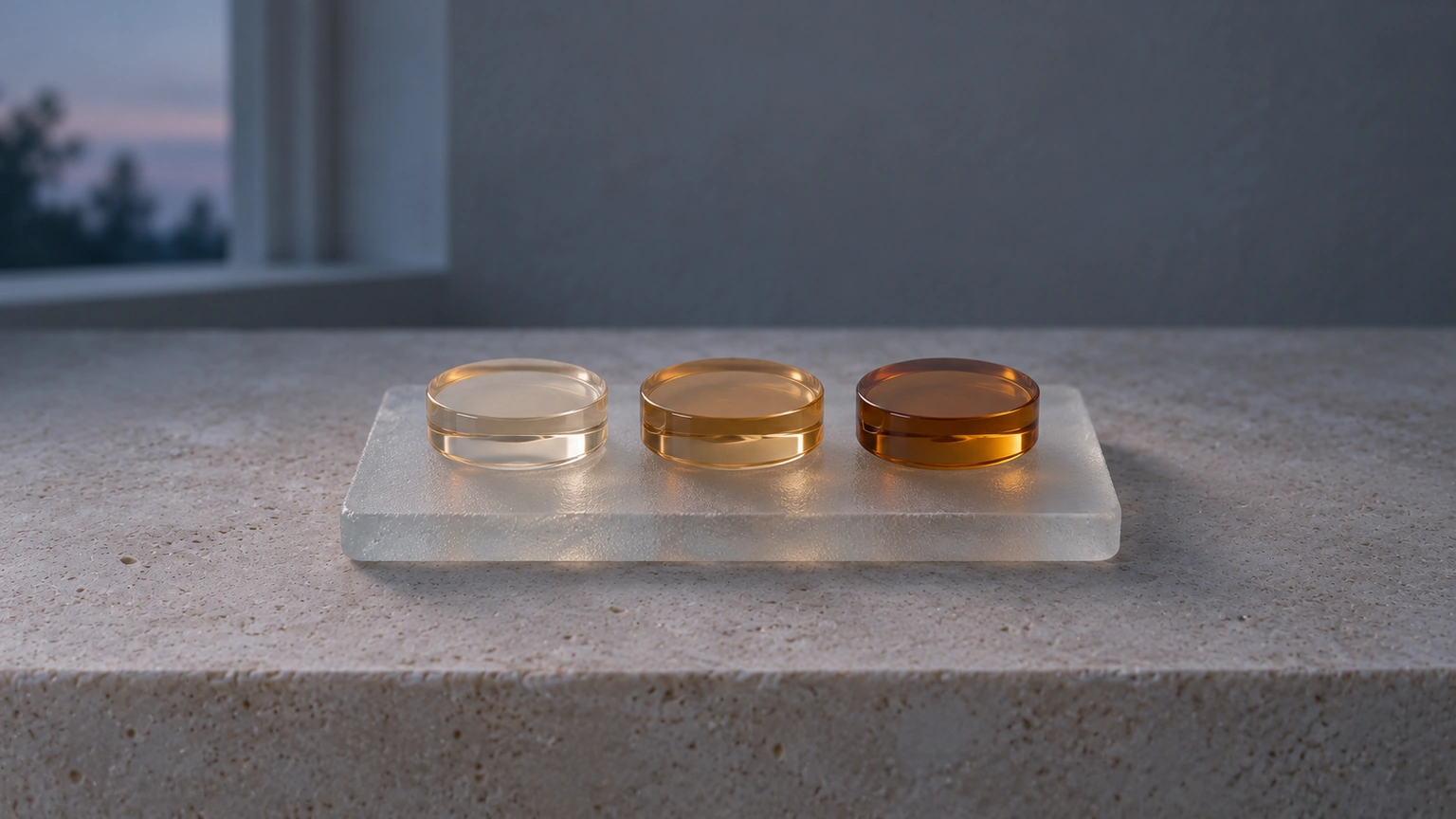
Safety note: Pregnant, trying to conceive or breastfeeding? Retinoids stay out unless your clinician says otherwise.
In 30 seconds
- Every retinoid works by becoming retinoic acid or acting like it. Fewer steps away means stronger
- Shop ladder, mildest first: retinyl esters, then retinol, then retinal, one step from retinoic acid
- Adapalene is the mildest of the medicine retinoids. It’s over the counter in the US, prescription in most other places
- Tretinoin and tazarotene are prescription only, stronger and more likely to burn or peel
- Percentages only compare within one form: 0.1% retinal and 0.1% retinol aren’t the same dose
Retinal (retinaldehyde) is one conversion step closer to retinoic acid than retinol, so on paper it’s the stronger of the two, while still being a shop ingredient. Adapalene is a different thing: a lab-made acne retinoid that acts on retinoid receptors directly. Tretinoin is retinoic acid itself, prescription only.
One idea makes the whole family click: your skin responds to retinoic acid. Everything on the shelf is either a step on the way to it or a molecule built to act like it. Count the steps and you can roughly predict how strong a product is and how likely it is to sting.
Retinol vs retinal: what’s the difference?
Retinol needs two oxidation steps to become retinoic acid: first into retinal, then into retinoic acid. Retinal skips the first one. Retinyl esters, like retinyl palmitate and retinyl acetate, add a step at the very start, because the ester has to be split off before anything else can happen. A 2019 review in Advances in Dermatology and Allergology puts the end of the ladder in perspective: retinoic acid is roughly 20 times more powerful than retinol.
The conversion ladder, from mildest to strongest
- Retinyl palmitate or retinyl acetate
Turned into retinol first. The mildest of the family, and the 2019 review notes it thickens the epidermis less than retinol does.
- Retinol
Two steps from retinoic acid. In cosmetics it usually sits between 0.0015% and 0.3%, according to the same review.
- Retinal (retinaldehyde)
One step away. The review describes it as less irritating than retinoic acid and well tolerated.
- Retinoic acid (tretinoin)
The active form itself. Nothing left to convert, which is why it’s a prescription medicine.
Types of retinoids compared: strength, irritation, where to buy
Shop retinoids vs medicine retinoids
In shops (cosmetics)
- Retinyl esters: three steps from retinoic acid. The mildest and slowest, a fair pick for very reactive skin
- Retinol: two steps away and the classic first retinoid. A 2006 review counts it among the retinoids that are considerably less irritating than tretinoin
- Retinal: one step away. Beat retinol in a small 8-week trial, and still much milder than the prescriptions
Medicines (prescription, or OTC adapalene in the US)
- Adapalene 0.1%: lab-made and receptor-selective. Of the retinoid medicines, DermNet rates it the least irritating. Best for clogged pores and breakouts
- Tretinoin: retinoic acid itself. The most studied retinoid for sun-related aging, and one of the two most irritating, with tazarotene
- Tazarotene: used at 0.05% to 0.1%. The 2006 review groups it with tretinoin as the ones most likely to cause burning or scaling
- Trifarotene: the newest prescription retinoid, built to target one retinoid receptor in the skin very specifically
Retinal vs retinol: which is better?
On paper, retinal should win, and the little human evidence there is points the same way. In a 2021 split-face trial, 23 Korean adults put a retinal cream (0.05% or 0.1%) on one side of the face and retinol at the same strength on the other for 8 weeks. Both sides improved on wrinkle depth, hydration and elasticity, the retinal side improved more on most measures, and nobody reported side effects. That’s one small study of one formula, though. Think of retinal as a sensible next step once retinol feels easy, not a sure upgrade.
Why retinoid percentages don’t compare
A bigger number on a retinol doesn’t make it stronger than a retinal with a smaller one. Each step on the ladder changes how much ends up as retinoic acid, so a percentage only compares within the same form. And for medicines, small numbers are strong numbers: tazarotene works at 0.05% to 0.1%, adapalene at 0.1%.
Adapalene vs tretinoin: the acne retinoids
Adapalene is selective: it targets particular retinoid receptors, which is part of why DermNet rates it the least irritating of the retinoid medicines. Tretinoin is the original, with nothing to convert, more power and usually more peeling. A 2006 review calls tretinoin the most widely studied retinoid for photoaging, so it’s the one with the deepest evidence for lines and sun damage. For clogged pores and breakouts, adapalene is the usual first step.
Where can you buy adapalene?
Where you live matters. In the US, adapalene 0.1% gel moved from prescription to over the counter in July 2016, and in May 2026 the FDA approved an over-the-counter gel that combines adapalene 0.1% with benzoyl peroxide 2.5%. In the UK and most other countries, adapalene is still prescription only. Tretinoin and tazarotene need a prescription in every country Nubia is in.
Trend check: bakuchiol and HPR
Bakuchiol is a plant compound, not a retinoid, sold as a retinol alternative. The trial most people quote is a 12-week, double-blind study of 44 people in the British Journal of Dermatology (2019): bakuchiol 0.5% twice a day and retinol 0.5% once a day both reduced wrinkle area and hyperpigmentation, with no statistical difference between them, and the retinol group reported more scaling and stinging. Promising, but it’s one small trial.
HPR (hydroxypinacolone retinoate) is an ester of retinoic acid that’s marketed as a low-irritation retinoid. Most published human studies test it blended with retinol, peptides or other retinoids, so it’s hard to tell what HPR does on its own, and the big claims are still early.
Which retinoid should you start with?
Pick by what you want
- New to retinoids, after smoother texture or early lines
A low-strength retinol.
- Retinol has felt easy for a few months
Retinal is the next step up.
- Clogged pores and breakouts
Adapalene: over the counter in the US, on prescription in most other countries.
- Very reactive skin
Retinyl esters, or bakuchiol if retinoids never work out.
- Deep, painful or scarring acne, or no change after 12 weeks
A dermatologist, who can prescribe tretinoin, tazarotene or other options.
Whichever one you choose, Nubia gives it a couple of nights a week to begin, on nights of its own, and waits for your check-ins to say your skin’s happy before it adds another.
Safety note: Pregnant, trying to conceive or breastfeeding? Nubia keeps every retinoid out of your routine, adapalene included, unless your clinician says otherwise.
Common questions
Is retinal a typo for retinol?
Nope, they’re two different ingredients. Retinal (retinaldehyde) sits one step closer to retinoic acid than retinol does.
Is retinyl palmitate a waste of money?
Not a waste, just slow. It’s three steps from retinoic acid, so it’s the mildest and least powerful retinoid on the shelf. It suits very reactive skin, less so anyone after visible change.
Retinoids, slowly
Part 2 of 70 of 7 read on this browser
 Up next · Part 3 · 7 min readHow to start retinol: a 12-week plan for beginners
Free to read, no account needed. Your ticks stay in this browser until you bring them to Nubia.
Sources
- Retinoids: active molecules influencing skin structure formation in cosmetic and dermatological treatmentsAdvances in Dermatology and Allergology (Zasada M, Budzisz E), 2019, accessed November 5, 2026
- Topical retinoids (vitamin A creams)DermNet, accessed November 5, 2026
- Retinoids in the treatment of skin aging: an overview of clinical efficacy and safetyClinical Interventions in Aging (Mukherjee S et al.), 2006, accessed November 5, 2026
- The efficacy and safety of multilamellar vesicle containing retinaldehyde: A double-blinded, randomized, split-face controlled studyJournal of Cosmetic Dermatology (Kim J et al.), 2021, accessed November 5, 2026
- Prescription to Nonprescription Switch ListU.S. Food and Drug Administration, accessed November 5, 2026
- Prospective, randomized, double-blind assessment of topical bakuchiol and retinol for facial photoageingBritish Journal of Dermatology (Dhaliwal S et al.), 2019, accessed November 5, 2026
More to read
Browse all articles
How often should you exfoliate your face? By skin type and acid
Once or twice a week is the starting point. Adjust by skin type, pick between AHA, BHA and PHA, and learn the signs you’ve overdone it.
What are actives in skincare? What they do and what not to mix
Retinoids, acids, vitamin C, benzoyl peroxide: what counts as an active, what each one’s for, which pairs to keep apart, and why one at a time wins.